
- Vibe Coding
- AI
- Technical Debt
- Refactoring
- B2B
In early 2025, Andrej Karpathy popularized the term “vibe coding”: building software by conversing with an AI, accepting the generated code largely unread, and moving on as soon as it appears to work. Little more than a year later, the practice has spread from hobbyists into real businesses. As an engineer with roughly two decades in this trade, I am not writing from the anti-AI camp. My team uses Claude and GPT daily. Precisely because we use them daily, we see clearly where these tools shine and where they quietly plant mines. This article draws that boundary as honestly as I can.
First, credit where it is due: AI is excellent at prototypes
From an end-user’s perspective, vibe coding is a small revolution. A non-technical founder can stand up a fundraising demo in an afternoon. A department can build its own internal tool instead of waiting a quarter in the IT queue. A product idea gets validated with real users in days rather than months.
For those goals, the quality of the code underneath barely matters. A prototype exists to answer exactly one question: is this idea worth pursuing? Once answered, its job is done. Trouble begins only when that prototype is not thrown away but wired directly into real customers, real data and real revenue. At that point, the following five problems surface one by one.
1. Technical Debt Explosion
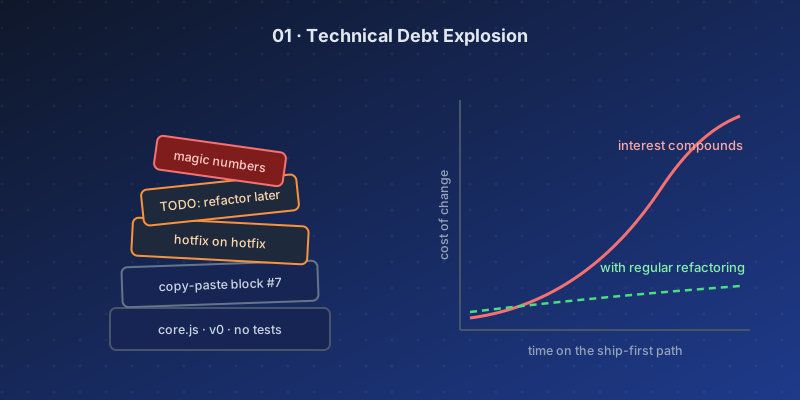
Why does AI accumulate debt so quickly? An LLM optimizes for “runs correctly in the current context”, not for “stays easy to change six months from now”. Each prompt produces a largely independent generation: the model carries no memory of the conventions it used last time, so the same logic gets rewritten in three or four different styles across the codebase instead of being extracted into a shared function. And because the vibe coder never reads the output, nobody notices the duplication.
The consequences compound like interest. Fix a bug in one place and four copies of the same logic elsewhere still carry it. With no tests, nobody dares delete dead code. The cost of every change grows non-linearly until adding a small feature costs more than rewriting the module. In finance, that state has a name: default.
2. Spaghetti Architecture
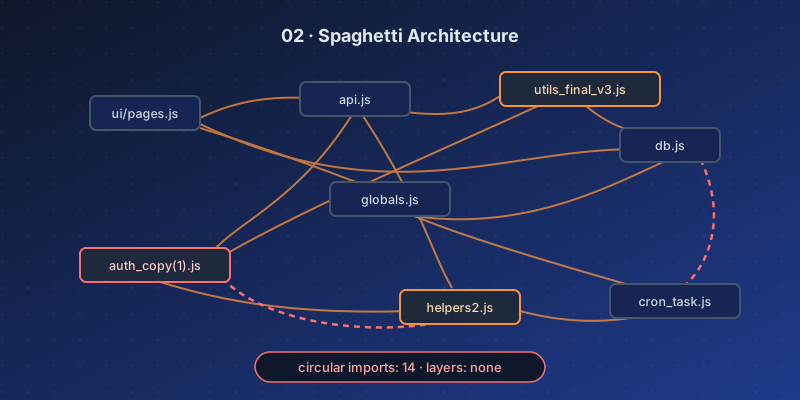
AI generates code in units of “answers”, not units of “systems”. It will not decide module boundaries or separate presentation from business logic unless the prompt explicitly demands it, and the vibe coder does not know to demand it. The typical result: a three-thousand-line utils_final_v3.js, everything importing everything, and a chain of circular dependencies that defeats even static analysis tools.
The worst consequence is not aesthetic. Without layering, you cannot replace one part without touching the whole: changing the database means editing thirty files, adding a notification channel means re-tracing every flow. New engineers cannot onboard because there is no map to read. The codebase becomes a black box even to the person who created it.
3. Cookie-Cutter Applications
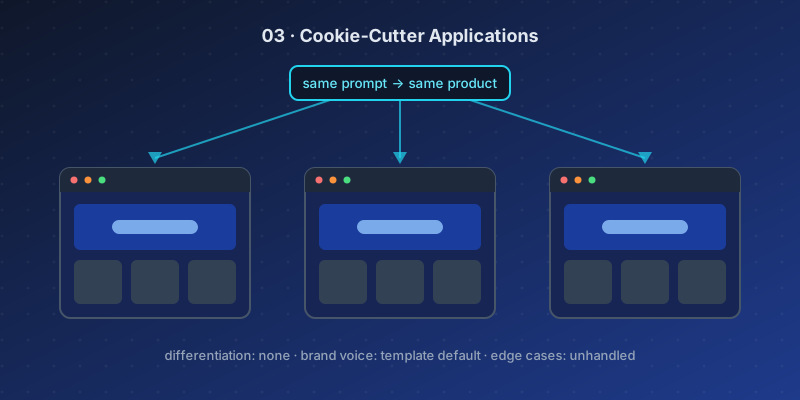
Models learn from millions of public repositories and the most popular templates, so their output converges on the common denominator: the same landing page layout, the same CRUD flow, the same default component library. Three companies in three different industries who vibe code their products will receive three applications that look strikingly alike, differing mostly in the logo.
For a demo this is harmless. For a commercial product it is a strategic problem: software is supposed to encode your specific business rules and competitive advantage, namely the industry edge cases and operating logic your rivals do not have. A template foundation cannot carry that depth of customization. The moment you need to bend the standard flow around your real operations, you find yourself fighting the very framework the AI chose on your behalf.
4. Zero Scalability
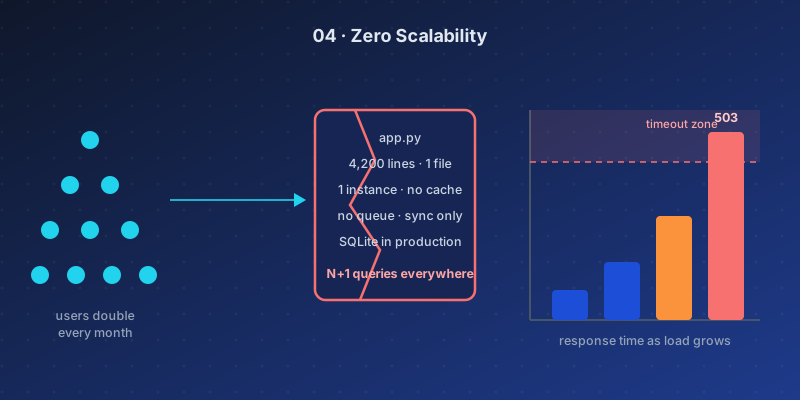
AI reliably picks the simplest solution that runs on a developer laptop: SQLite instead of a production database, synchronous processing instead of a queue, direct reads and writes instead of a cache, plus the classic N+1 query loops. This is not because the model is weak. It is because the prompt never said “this system will serve ten thousand concurrent users”, and a non-specialist does not know that it must be said.
The consequence arrives at the worst possible moment: when the product starts winning customers. Traffic doubles, response time increases eightfold. The bottleneck cannot be split into its own service because everything is welded together. The only escape is vertical scaling, renting a bigger machine, so the infrastructure bill climbs while the architecture stays exactly as fragile. We once took over an event ticketing system vibe coded in two weeks: it ran flawlessly for 50 test users and collapsed on its first on-sale night at 800 concurrent visitors.
5. Security Vulnerabilities
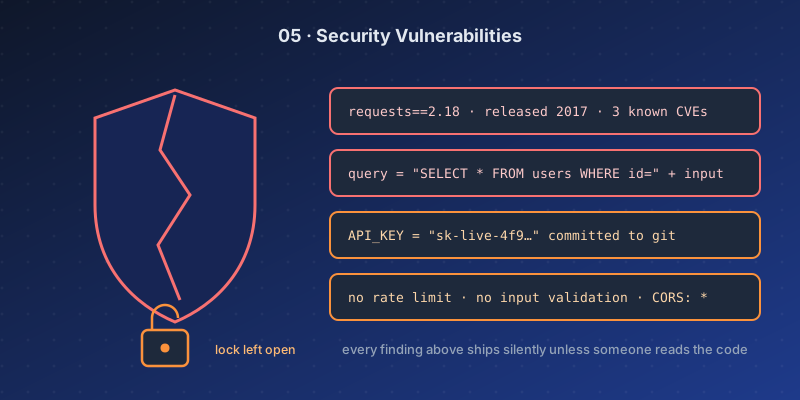
This is the problem I weigh heaviest, because it never shows up in the UI. Model training data ages, so AI regularly suggests outdated library versions with published CVEs and deprecated patterns. It can still produce string-concatenated SQL, hardcode API keys into source, skip input validation and open CORS to every origin. A Stanford study (“Do Users Write More Insecure Code with AI Assistants?”) found something more alarming: participants using an AI assistant not only wrote less secure code, they were also more confident that their code was secure.
With vibe coding there is no review step at all, so every vulnerability ships straight to production alongside customer data. The fallout extends beyond engineering: a personal data breach triggers legal exposure under GDPR, Vietnam’s Decree 13/2023 or Japan’s APPI depending on your market, plus a loss of customer trust that no invoice can measure.
The fix: “Software Sanitation”, turning a prototype into a production system
The good news: in most cases the answer is not a rewrite from scratch. An AI-built application has usually already proven its business value, which is its most precious asset. What it lacks is the engineering underneath. At OKAXI we call the process that supplies it Software Sanitation, delivered by our software outsourcing team in three measurable steps.
Step 1: Code Audit & Refactoring
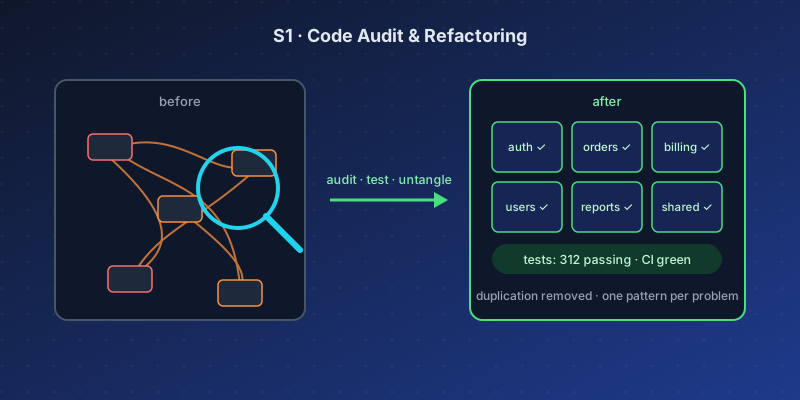
The first principle: measure before you cut. We run static analysis, build the dependency graph, measure test coverage and map the technical debt by risk level. Before touching a single line, the team writes characterization tests that pin down the system’s current behavior, guaranteeing the refactor changes structure without changing business logic. Only then does the cleanup proceed: merging duplicated logic, splitting modules by single responsibility, and putting everything under CI/CD so quality cannot silently regress.
Step 2: Architecture Re-design & Scaling
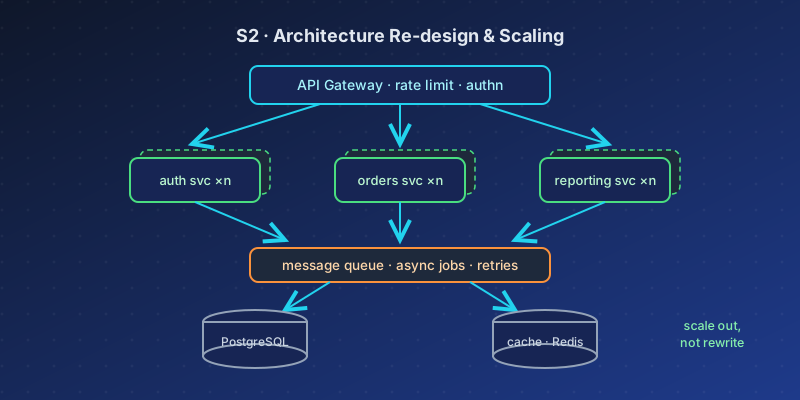
In parallel with the cleanup, we re-plan the architecture along business boundaries: clear layers, heavy work moved onto a message queue, caching and connection pooling added, and a path prepared toward microservices for the parts that genuinely need independent scaling, rather than splitting services because it is fashionable. Infrastructure moves to Infrastructure as Code with observability built in, so the next traffic surge means adding instances, not rewriting. For complex systems, this step can start with a standalone system architecture consulting engagement before committing to a roadmap.
Step 3: Security Hardening & Optimization
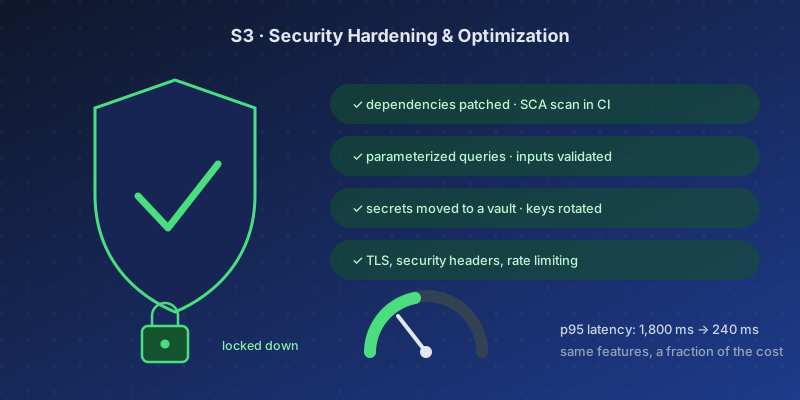
The final step addresses the submerged part of the iceberg: an SCA scan with full dependency upgrades, secrets moved into a vault and exposed keys rotated, string-built SQL replaced with parameterized queries, input validation, rate limiting, security headers and a tightened authorization model, closed out by a penetration test. Performance optimization belongs in the same step because the work overlaps: fixing N+1 queries and adding indexes and caching typically cuts p95 latency to a fraction of its starting value, which cuts the infrastructure bill with it.
Conclusion: AI is an accelerator, not a substitute for engineering
My position after all of this remains consistent: vibe coding is not the villain. It is the cheapest idea-validation mechanism in the history of software, and businesses should absolutely use it. The only mistake is confusing the draft with the product. AI writes code very fast, but engineering responsibility, spanning architecture, load resilience and data safety, still requires experienced engineers standing behind it.
If your company is running an AI-built application and starting to feel the symptoms described above, do not wait for the first incident. Let OKAXI’s software outsourcing service audit your system: you receive a clear assessment of the current state plus a staged sanitation roadmap, so the prototype that won you the idea round keeps winning in the operating round.